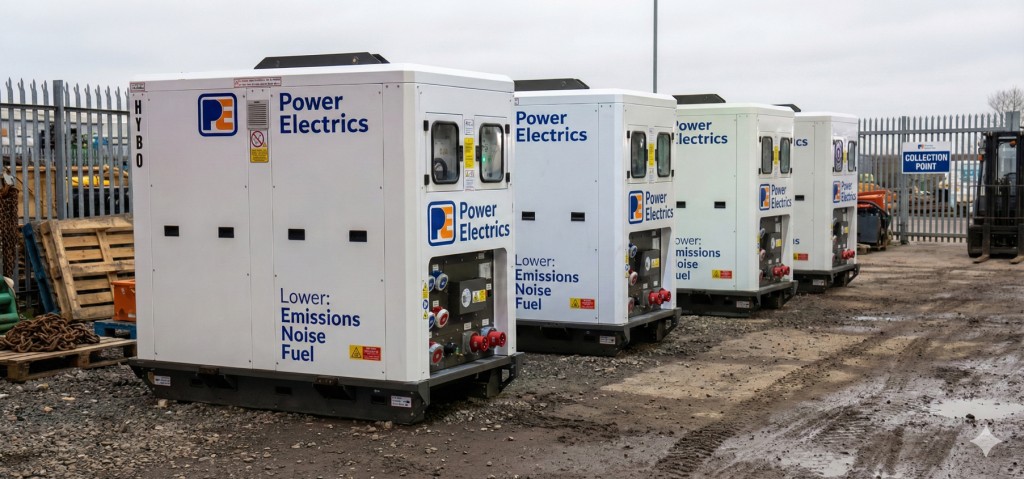
Across the UK, constrained grid capacity is rapidly becoming a defining factor in project delivery. For construction, infrastructure and industrial sites, the available electrical connection is often significantly lower than operational demand.
Where a grid connection exists, it is governed by a capacity agreement that sets a strict maximum demand. That ceiling is typically defined by network availability rather than project need. Exceeding it, even momentarily, can result in financial penalties, increased standing charges or automatic supply restrictions.
The core issue is not total energy usage. It is peak power demand.
Most sites operate with highly dynamic load profiles, yet grid agreements assume a fixed upper limit. That structural mismatch creates commercial risk and operational constraint.
Why Construction Site Power Demand Exceeds Grid Capacity Limits
Temporary and semi-permanent sites rarely draw power evenly. A predictable base load is overlaid with short-duration, high-intensity peaks throughout the day.
Simultaneous activation of welfare facilities, heating cycles across multiple cabins, equipment start-up loads, tower crane operations and clustered EV charging all generate transient spikes. While these peaks may last only minutes, they define the site’s true electrical requirement.
On the national grid, fluctuations of 20–50 kW are insignificant. On a restricted 50 kW construction site connection, they are critical.
Without an intelligent solution, projects typically face three options: apply for grid reinforcement, deploy diesel generators to manage peaks, or risk breaching capacity agreements. Each option increases cost, complexity or carbon impact.
How Battery Energy Storage (BES) Systems Enable Peak Shaving and Grid Compliance
Battery Energy Storage (BES) units provide a practical and scalable solution to limited grid capacity.
Rather than increasing supply, BES optimises demand. The grid import is capped below the agreed maximum demand, creating a controlled ceiling. When site demand is below this threshold, surplus grid power charges the battery. When demand rises above it, the battery discharges instantly to supply the difference.
From the grid’s perspective, demand remains stable and within agreed limits.
From the site’s perspective, operational flexibility is maintained.
This approach – known as peak shaving – removes visible demand spikes without restricting productivity. Because battery systems respond in milliseconds, they are ideally suited to managing short-duration load fluctuations common on construction and infrastructure projects.
The outcome is engineered compliance with grid capacity agreements.
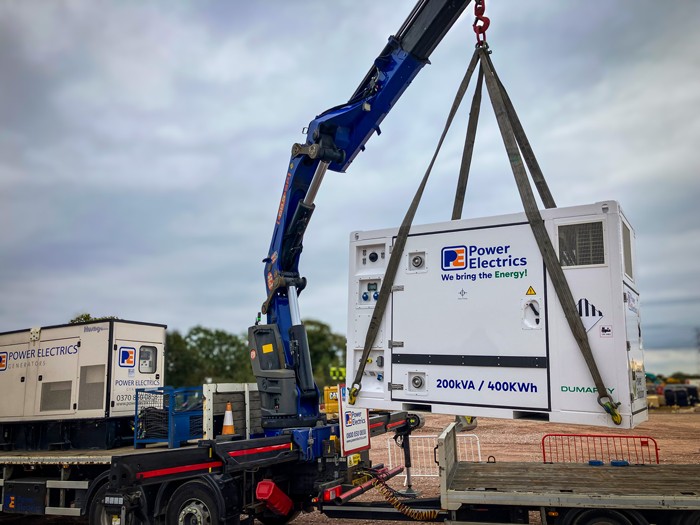
Managing Capacity Agreements with Battery Energy Storage
Capacity compliance should be built into system design, not managed reactively.
For example, a site operating under a 50 kW capacity agreement can configure its energy management system to cap grid import at 45 kW. If operational demand rises to 70 kW, the battery supplies the additional 25 kW, ensuring the grid never sees more than the permitted limit.
This transforms capacity management from a commercial risk into a technical certainty. Penalties are avoided, standing charges remain predictable and supply stability is protected.
Importantly, this strategy reduces reliance on diesel generators as a peak-balancing solution.
Avoiding Grid Reinforcement with Hybrid Power and Battery Storage
Grid reinforcement projects are often capital-intensive and subject to long lead times. For time-sensitive construction and infrastructure programmes, they rarely align with delivery schedules.
Battery Energy Storage, particularly when integrated into hybrid power solutions, offers an immediate alternative. It enables additional electric plant, expanded welfare provision and EV charging infrastructure to be deployed without increasing apparent grid demand.
By combining BES units with generators or renewable inputs, sites can reduce generator runtime, lower fuel consumption and decrease emissions while maintaining operational resilience.
In constrained environments, battery storage effectively creates virtual grid capacity – unlocking usable power beyond the physical limits of the connection.
Power Electrics Battery Energy Storage Solutions for Temporary and Permanent Site Power
At Power Electrics, Battery Energy Storage Systems are delivered as part of a fully engineered site power solution.
Each deployment begins with detailed analysis of load profiles, peak demand patterns and grid constraints. Battery sizing, control logic and integration strategy are designed around measurable operational data. Systems are configured to maintain strict grid import limits while optimising battery utilisation and minimising generator dependency.
This integrated approach enables:
- Predictable compliance with grid capacity agreements
- Reduced diesel consumption and carbon emissions
- Improved resilience during demand spikes
- Scalable power solutions aligned with programme requirements
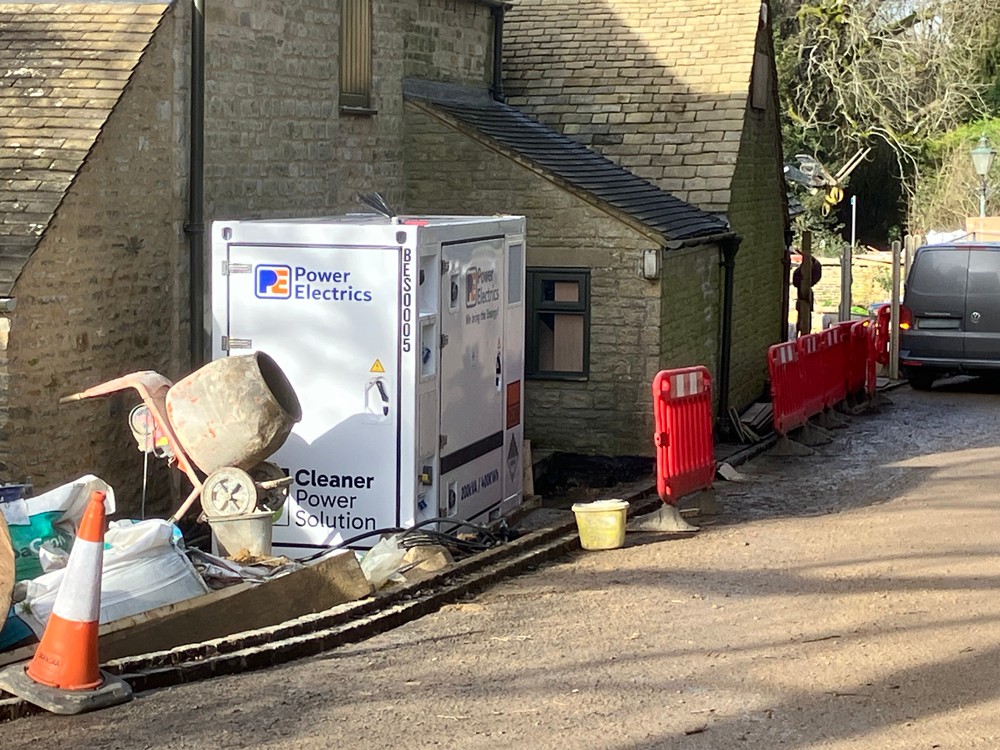
As grid constraints become more widespread across the UK, the ability to deploy rapid, reliable and intelligently managed BES units is becoming central to modern site power strategy. A recent project illustrates this in action, a customer found themselves in an increasingly common position – a delayed new supply connection from the DNO, despite having a fixed opening date for their fully refurbished & fully electric hotel and bar.
To keep the project on schedule, we’re using Battery Energy Storage to peak shave the existing 100-amp grid supply and support peak loads of up to 230-amp, ensuring the venue operates smoothly without overloading the available connection.
Battery Energy Storage: A Strategic Solution to UK Grid Capacity Constraints
Grid limitation is increasingly structural rather than temporary. Projects that treat it as a fixed barrier face cost escalation and operational restriction. Projects that manage it strategically gain flexibility and control.
Battery Energy Storage Systems convert a fixed supply ceiling into a controllable parameter. By stabilising demand, enabling peak shaving and embedding compliance within system architecture, BES units allow sites to operate efficiently – even where grid capacity is limited.
In an environment defined by legislation, decarbonisation and network constraint, intelligent energy management is no longer optional. It is a competitive advantage.