
For many years, conversations around reducing emissions from temporary power centred on future technologies. Businesses were encouraged to think about what would come next, whether that was electrification, hydrogen or entirely new ways of powering sites.
Today, the conversation has changed.
Across construction, utilities, infrastructure and industrial projects, organisations are increasingly looking for practical ways to reduce emissions now, without compromising reliability or investing in entirely new fleets of equipment. That shift in thinking is one of the biggest reasons that demand for Hydrotreated Vegetable Oil (HVO) continues to grow. This shift is being reflected across the wider construction industry. Recent industry commentary highlights that many organisations are turning to drop-in renewable fuels such as HVO while they wait for commercially viable net-zero construction machinery to become more widely available. Rather than delaying progress, businesses are increasingly adopting solutions that can deliver immediate emissions reductions using existing diesel-powered equipment.
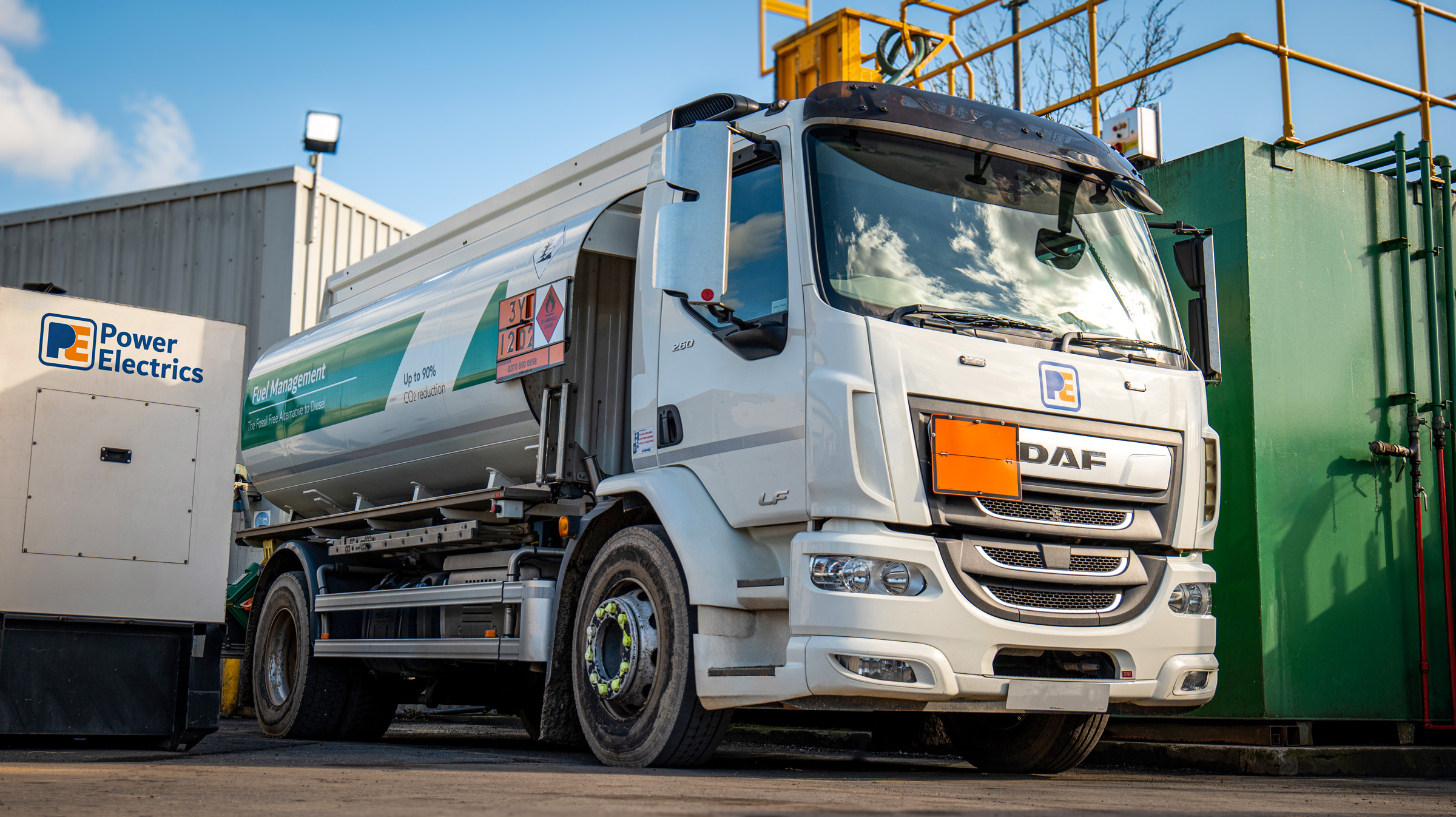
At Power Electrics, we’ve seen that change first-hand. Just four years ago, HVO represented only a small proportion of the fuel supplied to customers. Today, it accounts for around 20% of the fuel supplied annually, demonstrating how quickly organisations are embracing lower-emission alternatives where they make commercial and operational sense.
Sustainability Is No Longer the Only Driver
Reducing emissions remains a significant reason organisations choose HVO, but it is no longer the only consideration.
Businesses increasingly want solutions that deliver measurable environmental improvements without disrupting day-to-day operations. HVO does exactly that. Because it is a drop-in fuel, organisations can continue using compatible diesel generators, plant and machinery without modifying engines or replacing existing infrastructure.
For many project managers, this removes one of the biggest barriers to reducing emissions. KAPSARC also highlights that HVO’s appeal extends beyond its environmental credentials. Its compatibility with existing engines and fuel infrastructure means organisations can begin reducing emissions without major capital investment or operational disruption, making it a commercially practical step in the wider energy transition. Sustainability no longer must mean significant capital investment or operational change. This is why HVO is increasingly being viewed as a transition fuel rather than simply an alternative fuel. It allows organisations to continue operating existing diesel-powered assets while reducing emissions, buying valuable time until technologies such as electrification and hydrogen become commercially viable across every application. Instead, organisations can begin lowering emissions simply by changing the fuel they use.
That practicality is one of the reasons HVO is becoming increasingly attractive across temporary power applications.
Lower Emissions Without Compromising Reliability
Organisations are under increasing pressure to reduce their environmental impact, but reliability remains non-negotiable.
Whether powering critical infrastructure, construction sites or standby systems, temporary power must perform exactly when it is needed. HVO allows businesses to balance both priorities. One of the key differences between HVO and conventional mineral diesel is how the fuel is produced. Mineral diesel is refined from crude oil, whereas HVO is manufactured from renewable waste-derived feedstocks, such as used cooking oil and waste animal fats, through a hydrotreatment process. The result is a high-quality, paraffinic diesel fuel that is free from sulphur and fatty acid methyl esters (FAME), making it cleaner-burning while remaining fully compatible with many existing diesel engines. Unlike mineral diesel, HVO can also be stored for significantly longer periods without the degradation issues that can affect conventional fuel, making it particularly well suited to standby power and emergency generator applications.
The fuel offers significant reductions in harmful emissions compared with conventional diesel while maintaining the performance expected from modern diesel-powered equipment. HVO can reduce harmful emissions by up to 90%, alongside reductions in particulate matter, hydrocarbons, carbon monoxide and nitrogen oxides. Crown HVO also has a HFRR lubricity of around 350 microns – representing “best in class” compared to EN950 diesel and improved cold-weather performance. This helps protect the generator’s fuel system by reducing friction and wear inside fuel pumps and injectors. For customers, this means greater reliability, less risk of downtime and long-term protection for valuable Stage V equipment they are hiring.
For organisations looking to make meaningful progress towards sustainability targets without introducing unnecessary operational risk, that combination is becoming increasingly compelling. This growing confidence is also being reflected by equipment manufacturers. Rolls-Royce Power Systems recently confirmed it had switched its mtu engine testing facilities in Germany to HVO, reporting CO₂ savings of approximately 3,200 tonnes by the end of 2025 while continuing to test the same diesel engine platforms. The company also noted that approved engines required no technical modifications to operate on HVO, reinforcing its practicality as a lower-emission alternative to conventional diesel. The role of HVO is also reflected by its usage across sectors where resilience is critical, in 2026 Bridge Data Centres successfully completed an HVO-powered backup fuel pilot across its Asia Pacific campuses, demonstrating that HVO could support emergency generator start-up, load transfer and sustained operation while meeting both performance and emissions targets. Following the success of the trial, the company announced plans to expand the use of HVO across its data centre portfolio, reinforcing confidence in HVO as a practical lower-emission solution for mission-critical backup power.

Operational Benefits Are Becoming Better Understood
Another interesting development is that customers are beginning to appreciate benefits that extend well beyond emissions, fuel storage being a good example of this.
Many standby generators spend long periods without operating, meaning fuel can remain in storage tanks for months or even years. Conventional diesel can deteriorate over time, creating problems that may only become apparent when equipment is needed most.
HVO offers a significantly longer storage life, remaining stable for up to ten years. For operators responsible for emergency standby power, this provides greater confidence that fuel quality will be maintained over the long term while reducing the likelihood of storage-related issues affecting equipment reliability.
As awareness of these operational advantages grows, more organisations are beginning to view HVO as a resilience decision as much as an environmental one. This is already being demonstrated on major projects: when Power Electrics delivered the temporary power solution for the 2023 Royal International Air Tattoo, the entire event was powered using HVO Green D+ fuel alongside Battery Energy Storage (BES) systems. By combining the two technologies, the project reduced diesel consumption by more than 25,000 litres compared with the previous year, while also lowering carbon emissions, nitrogen oxide (NOx) and particulate emissions across the site.
These operational advantages are one of the reasons HVO adoption continues to accelerate. As Volvo Trucks notes, HVO allows organisations to achieve significant carbon reductions with minimal disruption and without investing in new vehicles or infrastructure.
Adoption Will Never Be Driven by Sustainability Alone
One lesson the industry has learned is that sustainability alone rarely determines purchasing decisions.
When HVO prices increased significantly because of growing international demand and supply pressures, some organisations temporarily reverted to diesel despite their environmental ambitions. Commercial realities inevitably influence procurement decisions, particularly for smaller businesses operating within tight project budgets.
However, as supply has improved and pricing has become more competitive, many organisations have returned to HVO. New production facilities are expected to increase availability further, helping renewable fuels become an increasingly practical option across more sectors.
The continued growth in demand suggests organisations are making long-term decisions rather than responding to short-term market fluctuations.
Trust Is Becoming Just As Important As Sustainability
As HVO becomes more widely adopted, customers are asking increasingly informed questions.
Where does the fuel come from? How is it produced? Can its sustainability claims be verified? These are becoming just as important as performance or price.
Working with suppliers that participate in recognised renewable fuel certification schemes such as the Assurance Scheme initiative designed and managed by Zemo Partnership that Power Electrics is signed up to, gives organisations confidence that the fuel they purchase has been responsibly sourced and independently verified. As environmental reporting and supply chain transparency become more important, certification is likely to become an increasingly significant factor when selecting both fuel and fuel suppliers.
Looking Beyond Alternative Fuel
The continued growth of HVO reflects something much broader than the adoption of an alternative fuel.
It demonstrates a shift in how organisations are approaching decarbonisation. Rather than waiting for future technologies to become commercially viable, businesses are increasingly implementing solutions that can deliver immediate environmental benefits while fitting seamlessly into existing operations.
Demand continues to grow because it provides organisations with a practical, proven and immediately deployable way to reduce emissions today while maintaining the reliability that temporary power demands.