Sustainability has shifted from a “nice-to-have” to a core requirement across the UK construction sector. Whether driven by legislation, client expectations or internal ESG strategies, temporary power is now under the same scrutiny as every other part of a project’s footprint. Construction project footprints are increasingly under the spotlight as the sector faces unique regulatory, commercial and reputational pressures. Stricter UK legislation: including NRMM emissions standards, Stage V compliance, MCPD requirements and local authority air-quality controls means emissions from site plant and temporary power face intensified inspection.
At the same time, major contractors and developers are under growing pressure from public-sector frameworks, planning conditions and funding bodies to evidence measurable reductions in carbon, noise and air-quality impacts at site level. Overlaying this is the rise of construction-specific ESG commitments, where sustainability reporting increasingly extends beyond finished assets to include the environmental performance of the build itself. As a result, every element of site infrastructure, including temporary power, is now expected to contribute demonstrably to cleaner, quieter and more efficient construction.
According to the Accountancy and Business Advisory firm BDO UK, their ESG strategies and sustainability in the UK Construction Sector Report states that companies are winning tenders based on lowest carbon emissions rather than price, indicating that across the construction landscape, priorities have shifted dramatically. But why has sustainable power become such a driving force and how is modern technology reshaping what’s possible on site?
Why sustainability now? The two forces driving change
Reducing carbon output, limiting emissions and using increasingly scarce resources more efficiently are now business-critical. This is particularly highlighted by the UK’s Net Zero Target of requiring a 100% reduction in greenhouse gas emissions (compared to 1990 levels) by 2050. As well as the legal onus on businesses to meet these regulations, customers want solutions that improve the environment they work in – not just meet a regulatory baseline.
At Power Electrics we take a holistic approach, our engineers and project managers will work with the customer to ensure a bespoke plan for their temporary power that is fully compliant with all relevant legislation, while also improving the local environment for employees and the public. This commitment to sustainability is particularly seen in our game-changing power solution case study where we developed a diesel-free power set-up for the medical scanners, resulting in zero emissions and significant cost savings for the NHS. The same principles can be applied across the construction sector, where intelligent load management, hybrid systems and battery energy storage can dramatically reduce generator runtime, fuel consumption, noise and emissions – delivering cleaner, more efficient power without compromising reliability or site productivity. We take the view that we should be looking to be as sustainable as possible to improve the living environment we’re in, reducing carbon output and being more efficient with resources like oil and fuel. This is why we have embarked on our Commitment to Green, helping our customers to save over 55,298 tonnes of carbon in 2024 alone.
Commercial reality
Despite genuine environmental intent, construction is still a heavily cost-driven industry. The reality is that sustainability must make financial sense too. And increasingly, it does. This is showcased in the Net Zero Carbon 2025 report who highlight that ‘Adopting sustainable practices and net zero goals tends to reduce operational costs in the long run.’ This is essential for all businesses to future proof their operations and ensure they are operating compliantly. Additionally the UK’s Clean Power 2030 Action Plan emphasises how clean energy investment can reduce energy bills for businesses, protecting them from volatile fossil fuel prices.
Fuel savings, improved efficiency, noise reduction, and optimised generator runtimes all translate into measurable cost benefits for sites, particularly on long-term projects. This can be seen in our Reliable and Low-Emission Power for Temporary Classrooms for School case study, where by combining a BES Unit with two 275 kVA generators, we reduced generator runtime by more than 6,350 hours compared to a standard single-generator setup. This led to a saving of almost 60,000 litres of fuel and prevented over 190 tonnes of CO2 and 930 kilograms of NOx from being emitted.
The Influence of NRMM and MCPD: Progress with Challenges
Regulations like NRMM (Non-Road Mobile Machinery) and the Medium Combustion Plant Directive (MCPD) have become major catalysts for change – but they’re not always well understood. NRMM and MCPD affect the construction industry by placing stricter limits on emissions from site plant and temporary power equipment, particularly diesel generators.
NRMM drives the transition to cleaner, Stage V-compliant engines, while MCPD introduces emission limits, monitoring and permitting requirements for larger or longer-running generators. Together, they encourage construction projects to reduce generator runtime, improve efficiency and adopt lower-emission or hybrid power solutions to stay compliant and minimise environmental impact.
Where the rules are enforced, Stage V generators, hybrid systems and BES setups become essential. Where enforcement is weak, cost-driven choices still lead some contractors toward older, non-compliant equipment – sometimes supplied by less scrupulous providers. While older, non-compliant equipment may appear cheaper at the outset, this perception rarely reflects the true cost of running a construction site. Less efficient generators typically consume significantly more fuel, require more frequent maintenance and are more prone to downtime – costs that quickly outweigh any initial saving. In contrast, Stage V, hybrid and battery-supported systems are designed to optimise fuel use, reduce engine wear and minimise unplanned interruptions, delivering measurable savings over the life of a project. When fuel consumption, servicing, reliability, noise restrictions and the risk of non-compliance are taken into account, lower-emission solutions often prove to be the more commercially sensible choice, not just the more responsible one.
Are Customers asking for Stage V and Hybrid Solutions?
Yes. Over the last six decades, there has been a clear rise in customers proactively requesting greener solutions, driven largely by internal sustainability teams, ESG frameworks and corporate commitments.
However, adoption still varies:
- Larger contractors are more able to absorb the upfront cost of Stage V or hybrid systems.
Hybrid solutions, on the other hand, often become cost-neutral or cost-beneficial over time – especially when fuel savings quickly offset the initial investment. It doesn’t take very long to save enough fuel to cover the cost of the extra equipment involved in battery storage systems as shown in our Hybrid Solar Systems Case Study, where the system reduced generator run-time and fuel usage by 50% and saved over 4500kg in CO2.
BES on Construction Sites: Optimising Energy and Reducing Wasted Fuel
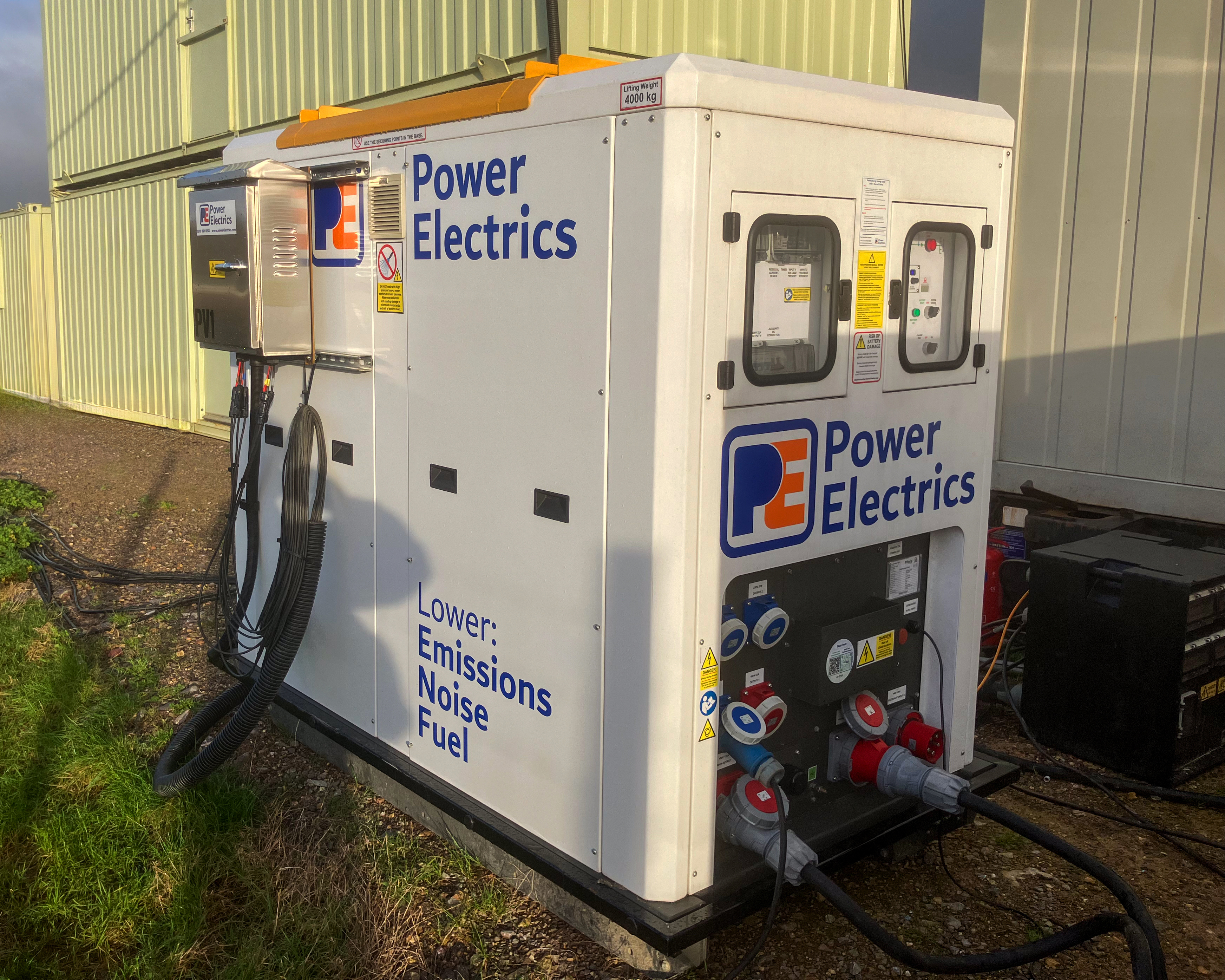
Battery Energy Storage Systems are now one of the most transformative elements of modern temporary power. Battery Energy Storage (BES) units are fundamentally changing how temporary power is delivered on construction sites. By intelligently managing energy demand, BES systems allow generators to run only when needed and at optimal loads, dramatically reducing fuel use, emissions and noise. They enable silent or low-emission operation during off-peak hours, improve site efficiency and resilience, and make hybrid power setups both practical and cost-effective -shifting temporary power from a purely reactive necessity to a smart, optimised energy solution.
Find out more about BES units in our Ultimate Guide to BES Units blog here
BES Unit role
- Energy optimisation
BES allows generators – Stage V or otherwise – to run at their optimal load. This avoids issues like wet stacking, low-load inefficiency and unnecessary fuel burn.
- Delivering silent, low-emission or emission-free power
Many construction sites require 24/7 power for security systems, welfare facilities and safety lighting. BES enables quiet, overnight power with minimal or zero generator runtime.
- Reducing engine wear
By smoothing out load profiles, BES extends the life of generators and improves reliability across the project.
Addressing common misconceptions about batteries and hybrid power
“Batteries are dangerous.”
Social media has amplified rare examples into perceived risks such as rare cases of thermal runaway in large, fixed energy storage installations or poorly designed, non-certified battery systems, rather than professionally engineered temporary power units. These events are frequently misrepresented, overlooking the fact that modern BES systems used on construction sites incorporate robust safety controls, monitoring and containment. In reality, lithium battery systems are no more dangerous than diesel engines when properly engineered, installed and maintained.
“Lithium isn’t ethical.”
There is growing scrutiny around how battery materials such as lithium are sourced, but this needs to be viewed in context. The environmental and ethical challenges associated with mining are increasingly being addressed through tighter supply-chain controls, improved standards and the use of second-life batteries – while also standing in stark contrast to the well-established environmental, health and geopolitical impacts of extracting and burning fossil fuels. When compared like for like, modern battery systems – particularly those using repurposed or responsibly sourced materials, offer a far lower long-term environmental and ethical cost than the continued reliance on diesel combustion.
“Second-life batteries are second-hand.”
Second-life batteries are often misunderstood as being second-hand, but this isn’t the case. Power Electrics works with automotive-grade batteries that are brand new and unused, but didn’t meet the extremely tight performance tolerances required for vehicle applications. While they may fall slightly outside automotive specifications, they are perfectly suited to energy storage use, where operating demands are less intensive—allowing these batteries to be repurposed safely and effectively rather than unnecessarily scrapped.
Designing a hybrid system: What it really involves
Designing a hybrid system starts with one critical factor: understanding the load—and in construction, that load is rarely static. Construction sites evolve constantly as projects move from groundworks to fit-out, with changing equipment, varying working hours, temporary cabins, welfare facilities and intermittent high-demand plant all impacting power requirements. Drawing on decades of construction-sector experience, Power Electrics combines detailed on-site assessments with real-time data from BES telemetry to anticipate these fluctuations, adapt systems as sites change, and ensure power solutions remain efficient, resilient and correctly sized throughout the life of the project.
This approach allows us to actively optimise the system once it is live, rather than relying on fixed assumptions made at the outset. By analysing real-time telemetry data, we can fine-tune generator sizing, battery charge and discharge profiles, and runtime schedules to match actual site behaviour. If loads increase, reduce or change over time, the system can be adjusted to improve efficiency, reduce fuel consumption, minimise unnecessary generator hours and maintain the right level of resilience – ensuring the power solution continues to perform reliably as the project evolves.
Why Sustainable Power makes sense for UK Construction
Between tightening legislation, commercial pressures, client expectations and genuine environmental responsibility, sustainable power isn’t just preferred—it has become essential for the future of UK construction. It aligns environmental responsibility with practical, commercial outcomes. How energy is generated and used on site has a direct impact on emissions, air quality and resource consumption—issues that affect everyone, both at work and beyond. As legislation tightens and client expectations rise, construction projects are under increasing pressure to demonstrate cleaner, more efficient operations. When combined with the proven cost savings, efficiency gains and resilience offered by modern low-emission and hybrid power solutions, sustainable power is no longer just a responsible choice – it is a logical and necessary one for the future of UK construction.